
Ethyl
She did not settle. She took off.
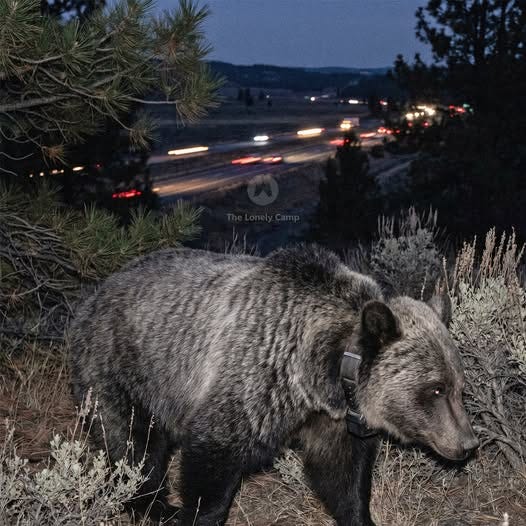
A twenty-year-old female grizzly bear walked 2,800 miles across Montana and Idaho over three years, crossed Interstate 90 multiple times, passed through downtown Lolo at night without a single person seeing her, and walked right past a municipal landfill without stopping.
Her name was Ethyl, and she was named after the owner of the apple orchard where Montana Fish, Wildlife and Parks first caught her in 2006.
Ethyl had spent most of her life in a small home range around Lake Blaine, between the tourist town of Bigfork and the Swan Mountains. For a female grizzly, that was normal. Sow grizzlies in the Northern Continental Divide Ecosystem average home ranges of about seventy square miles. One of Ethyl’s neighbors in the Mission Mountains held a home range of three square miles, denning on the mountainside and foraging in a boggy basin all summer. Female grizzlies are not wanderers. They find a territory that feeds them, and they stay in it.
Ethyl got caught raiding apples in 2006 and was relocated to the Wounded Buck Creek drainage along Hungry Horse Reservoir. She came back. In 2012, she was caught at the same orchard with a two-year-old cub. This time, bear specialist Rick Mace fitted her with a satellite-linked GPS collar and relocated her to the Puzzle Creek drainage, deep against the Continental Divide south of Marias Pass. It was remote enough that biologists expected her to settle.
She did not settle. She took off.
The GPS collar logged coordinates once a week, and when biologists started mapping the data, they watched a female grizzly do something no female grizzly had ever been documented doing. She prowled the Bob Marshall Wilderness for a while. She peeked out at the Rocky Mountain Front between Lincoln and Augusta. She drifted south to the Mission Mountains and the Jocko Lakes area. Then she cleared Highway 93, headed for the northern Bitterroots, and crossed Interstate 90 into Idaho.
I-90 is the single largest physical barrier to the reunification of the two biggest grizzly ecosystems remaining in the lower 48. It is a four-lane freeway running through mountain valleys with heavy truck traffic. Ethyl crossed it. She may have crossed it several times. She explored the mountains around Kellogg and Wallace and pushed all the way to the city limits of Coeur d’Alene before turning around.
The collar went dormant in November 2012 to conserve battery power during hibernation. When it reactivated in the spring, Ethyl was already moving. By May she had reached the southern outskirts of Missoula. On May 20, she walked through downtown Lolo in the middle of the night. A town of four thousand people. She passed through and nobody saw her. Chris Servheen, grizzly bear recovery coordinator for the U.S. Fish and Wildlife Service, described it plainly: she was minding her own business, walking around trying to figure out where she was.
She continued south through the Bitterroot foothills as far as Florence. Then she shot back into Idaho, reaching Coeur d’Alene again. Then back east, crossing I-90 again, past the Republic Services landfill outside Missoula. The GPS showed her approaching the landfill, sniffing, and moving on without raiding it. She cruised apple orchards near Evaro Hill and scavenged hunters’ gut piles in the fall, sleeping in the Rattlesnake Wilderness between forays.
Then she pushed north through the Bob Marshall again, bypassed her old Lake Blaine home range without stopping, and headed for Glacier National Park. After some time there she moved west toward Eureka on the western edge of the ecosystem. She lost her collar on October 17, 2014. Total distance logged: 2,800 miles. Servheen noted that the only place in the entire Northern Continental Divide Ecosystem she did not visit was the Blackfeet Indian Reservation.
The leading theory among the biologists who studied her track is that Ethyl was trying to find her way back to Lake Blaine after the second relocation and simply could not locate it. She came close. She passed near it at least once. But she never stopped there, and she kept moving in massive arcs across two states as if searching for something she recognized and never quite finding it. Rick Mace joked that Ethyl seemed to be traveling with a “Be People-Aware” brochure and a can of people-spray. She had learned from her two captures that humans meant trouble, and she applied that lesson across 2,800 miles of travel through the densest human infrastructure in the northern Rockies without a single conflict, a single livestock kill, or a single reported sighting until biologists pulled the collar data and realized where she had been.
Source: Montana Fish, Wildlife and Parks (FWP) / U.S. Fish and Wildlife Service / Interagency Grizzly Bear Committee (IGBC) Telemetry Data